Showing posts with label Card Games. Show all posts

Tuesday, 3 December 2013

Suggested block sealed formats of Magic: The Gathering

I was recently in discussions with a L3 Magic: The Gathering (MTG) judge from one of my local game shops (LGS), Games Laboratory, around the suggested / recommended configuration to be used when playing sealed deck format when it comes to block sets. Sealed deck is a form of a limited format where players make a 40 card deck from a restricted pool of cards. Over the history of MTG, the pool has varied, but it appears that the current most preferred pool is using 6 booster packs. Other ways in the past is by using a Tournament pack and some additional booster packs.

The sealed limited format in MTG is the format I play the most with my "kitchen table" group.

The L3 suggested for any Large-Small-Small block (and the size refers to the card pool size of each individual set), it should be 2 boosters from the first set, 2 boosters, from the second set, and 2 boosters from the third set. This will take into account the way blocks are designed. So therefore, we have come up with the following recommendations:

Return to Ravnica block (Return to Ravnica, Gatecrash, Dragon's Maze)

  • 2 from Return to Ravnica, 2 from Gatecrash, 2 from Dragon's Maze

Innistrad block (Innistrad, Dark Ascension, Avacyn Restored)
This block has the two types of sealed pools:
  • 3 from Innistrad, 3 from Dark Ascension
  • 6 from Avacyn Restored

Scars of Mirrodin block (Scars of Mirrodin, Mirrodin Besieged, New Phyrexia)

  • 2 from Scars of Mirrodin, 2 from Mirrodin Besieged, 2 from New Phyrexia

Zendikar block (Zendikar, Worldwake, Rise of the Eldrazi)
This block has the two types of sealed pools:
  • 3 from Zendikar, 3 from Worldwake
  • 6 from Rise of the Eldrazi
Alara block (Shards of Alara, Conflux, Alara Reborn)

  • 2 from Shards of Alara, 2 from Conflux, 2 from Alara Reborn
Note that this was the last block to have the Tournament Pack, so people that played MTG when this was released may have had different experiences.

Lorwyn-Shadowmoor block (Lorwyn, Morningtide, Shadowmoor, Eventide)
This block was actually made up of 2 mini-blocks, so the suggested way of doing a sealed game with these are:

  • 3 from Lorwyn, 3 from Morningtide
  • 3 from Shadowmoor, 3 from Eventide
I will stop there (for the moment), as I find it more difficult / expensive to obtain any sealed booster boxes older than the Lorwyn-Shadowmoor block.

I welcome any feedback around these suggestions / recommendation, and may edit this blog entry from time to time. Keep in mind, these are only suggestions and recommendations, and should not deter you from playing sealed formats with 6 different boosters from different sets.

Tuesday, 29 October 2013

Say "no" to eBay's Global Shipping Program

As some of you may know, I play Magic: The Gathering (MTG), and as someone who plays the games and collects the cards, a more cost effective way of gathering the cards is via eBay. I am not new when it comes to on-line shopping. I doubt many other people out there who are connected to the internet are also unaware of eBay. They connect sellers with buyers on a global scale.

Recently, eBay introduced a new feature for sellers in the USA - the Global Shipping Program (GSP). The GSP sounds like a great service - on the surface. Sellers in the USA package their goods, and send it to the GSP hub, in Kentucky, where Pitney Bowes takes over and ships it to international customers. As long as the seller gets it to the GSP hub, the service takes care of the rest. It will also calculate the international shipping costs, and any additional customs costs, and that will be all billed to the buyer.

But in reality, there are many problems associated with the GSP. The cost to cover such a service is very expensive. As I mentioned, I play and collect MTG cards. The cost of shipping 4 pieces of thin cardboard to me is around $US30. Who thinks that is reasonable? Even with padding / protection, expedited shipping, and tracking - it would be around the $US12 mark. My usual expectations for 4 pieces of thin cardboard safely shipping to me is around $US3 to $US4 per item. This will get cheaper (per unit) if the seller allows for combined shipping. Obviously, there is some additional mark-ups inserted into the GSP fee - which as I mentioned gets passed onto the buyer. While this make make it easier for the seller, it does not make it easier or cheaper for the buyer.

This video has someone discussing some of the other problems:

The video gets interesting around the 10m22s when the person in the video reads out a response sent to him from eBay around a dispute he has with damage to a product.

So, summing things up:
  • Greater costs get passed to the buyer
  • GSP opens up packages sent to them, and repackages them
  • Any disputes over damage are ignored by eBay
  • GSP has a "hands-off" approach to resolving disputes
  • No value declaration
  • It means less money in the hands of seller, as more goes to eBay - which in turn, means international buyers will not tend to spend as much for products US sellers may be offering
  • GSP also has a tendency for under-calculating the shipping costs of items seen on the search page when compared to the single item listing pages
What can you do as a buyer? Inform the sellers about the reality of GSP. Do some of your own research, weigh up comments from people who have bought products via the GSP. Most people use eBay to find bargains. Inform the users using GSP that you prefer sellers that "manually" ship items. If the fact that eBay fees are now making internet goods more expensive, support your local stores - buy from them.

What can you do as a seller? Deactivate GSP by doing the opposite of what is listed in this link, or via the steps listed in this eBay forum thread. Listen to your buyers. Without them, all you have is your product, and less potential customers.

Lastly, both groups can keep complaining to eBay. I am sure GSP has some benefits in some situations, but I am yet to see what those situations are, and am yet to read a glowing review of GSP, but I have read that eBay Global Shipping Program Exposes Sellers to Bad Feedback.

Wednesday, 10 April 2013

Magic: The Gathering resources on the web

I have been attempting for a while to document the websites I visit when I want information on Magic: The Gathering (MTG), and here is my current list (in no particular order):
I hope other people looking for resources for the game also find this list useful. I am sure there are plenty more sites, and others will have their favourites. I am happy to update this over time, if I find any more or am informed of any more.

Thursday, 3 May 2012

The revised SplinterWin deck on Android

I've recently been working on my Infinite Copies Modern deck for Magic: The Gathering (MTG), and this is the latest iteration of it:


SplinterWin (Modern) [blue/red]
CREATURES
NONCREATURES
LANDS
SIDEBOARDS
I have been working on this deck with my new Android phone and it the MTG toolbox application. The application itself is quiet interesting, but appears to be prone to crashing during mid operation. SpecialK has the same application on his iPhone, and it does not appear to have the same crashing problems. The application's features include a card viewer, a location finder, a news reader - all of this is to do with MTG, of course. Additionally, I am able to analyse the decks I create (seeing percentage breakdowns of different cards in the deck), build different decks at the same time, share the decks (via email or sms), and even draw sample hands.


Another fault (other than the random crashing) I have seen in the application is that during the simulated drawing of sample hands, there is a significant doubling up of cards in sequence. I do not think the randomiser works well. I have not seen behaviour like this in real life draws.


I am still keen to know of alternative applications, as well as decks in the modern format that are competitive against this deck, which can win by turn 4 around 35% of the time, and by turn 5 around 60% of the time. It would win easier if Preordain and Ponder were not banned in the format - but there are reasons for that, and it has been discussed in:
Other Modern format deck ideas have been discussed in:

Sunday, 29 April 2012

Avacyn breaks out of the Helvault

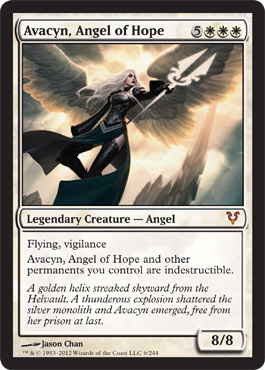
I can now confirm what was in the Helvault (as you may be able to see from my previous post). It is Avacyn breaking out of the promotional material:
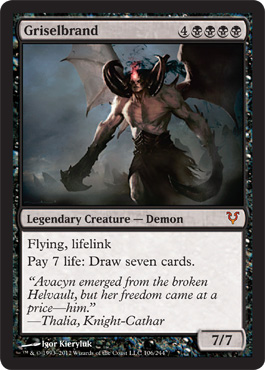
And I can also confirm that along with the promotional material, there was spindown life counters with the Avacyn Restored symbol on it, over-sized cards of Avacyn, other angels, and Griselbrand, and additionally, some Angel / Demon two sided token cards. All images of these products were spoiled a day or two before the release. I was fortunate enough to obtain the life counter and 4 of the the token cards. I did not try to get the over-sized cards - which I believe would be suited for Commander / EDH.

I am not overly impressed with this set in a sealed format, but neither am I disappointed with it. It has a feel that for this Magic: The Gathering (MTG) set, it is only somewhat connected to the rest of the block via its flavour and the undying mechanic. It did have a feel that it was made for the Commander / EDH format. I do not think this is a bad concept, but playing it in a sealed format meant I did not have much to do until turn 4 or 5. If my opponent could swarm out better smaller creatures than me, then he was able to subdue me. In my sealed pool, I did not have much that was large or any cards with the miracle mechanic - so I did not experience those mechanics. I did not feel that this set was strong enough to stand on its own. I believe that Innistrad, and even Dark Ascension were far better stand alone sets.

My final record was 1 win and 3 losses. This is a step down from the Dark Ascension pre-release where I won one more match, but better than the Innistrad pre-release where I did not win any matches.

Still, it was a great atmosphere at Games Laboratory. The staff there did a great job of organising and running the event.

Saying that, I have yet to play in a draft format with this set.

Does anyone want to comment on their experiences with the set so far?

Friday, 27 April 2012

What is inside the Helvault?

Games Laboratory has a Helvault for the Avacyn Restored set of Magic: The Gathering (MTG) pre-release tonight.


Anyone want to guess what is inside? I will confirm it tonight! Wish me luck!

Monday, 13 February 2012

Teams are winning - including me (sometimes)

For the first time in a few months, both the teams I am following are winning!

The Boston Celtics recently beat the Chicago Bulls, and the Melbourne Victory beat the Central Coast Mariners. The former teams play in the NBA, and the later teams play in the A-League. What makes both teams interesting to watch at the moment is they are both quality teams on paper, but are not really producing winning results (until recently). And while the Celtics are currently above a 50% win-loss ratio, the Victory are struggling to have wins on the board, having more matches end in draws than anything else.

GO CELTICS!!
GO VICTORY!!

Other than that, I have been playing in the Magic: The Gathering (MTG) prerelease tournament for Dark Ascension and in the MTG League at Games Laboratory. While I am not ruling the game, I am starting to win a few matches here and there. It feel better than just loosing every single game, but then again, I do not put as much effort into this game as I would like.

With the introduction of the new set for Dark Ascension, I have already seen some new ideas for my to add to my infinite copies of tokens deck which is powered by the Splinter Twin / Kiki-Jiki, Mirror Breaker combo. While it does not affect the main deck very much, the new mechanics from the latest set will definitely change what I believe should go into my sideboard. Cards that I believe will need to be considered in my sideboard are:
The exact quantities of the ones mentioned here is something I need to work on, as well as possibly including some duplicate of the spells in my main deck into my sideboard - up to the maximum of 4 of any card.

This leads me to the psychology of how people feel things based on how much control we have over the aspects in front of us. When it comes to cheering about a sporting team, no matter how much I cheer or oppose a team, it does not affect their final outcome. It comes down to those sports people and how they play, as to what results are achieved. It also comes down to their opponents and how well their opponents play as well. In summary to this situation, I am not too upset when a team I support looses, just somewhat annoyed.

When it comes down to a card game that I have some (perceived) "control" over, it does get a little bit beyond annoying if I had a possible win, and did not make the correct decisions, or choose the right elements at hand to bring forth a winning result. If I play against a deck that my opponent has tuned, play tested a lot, and I loose to it - I do not feel very bad. I noticed in the MTG League that most of my opponents have at least one, if not two, mythic rare cards. While some of those cards are awful to use, some (in the correct circumstances) are game changers. Loosing to those decks do not upset me. Winning to those decks is always a pleasant surprise, as I do not have any mythic rare cards in any of my MTG League decks. The only time I am upset is if through a mistake of my own, I loose to a deck that is underpowered or is on the same level as mine. Luckily, it has not happened much.

Sunday, 29 January 2012

Dark Ascension midnight pre-release survivor

I have survived another Magic: The Gathering (MTG) pre-release, and this one was with a better record than my last attempt at a pre-release (with Innistrad), where I did not win a single match. In the pre-release for Dark Ascension, I came out with a record of 2 wins and 2 losses.

This time around, FrankieG, SpecialK, and Jarvo joined me. Everyone, except Jarvo, had a great time. Jarvo did not like the competitive nature of the event - but then again, this game and this type of way of playing it is not for everyone. He will be now sticking to either casual playing, or not playing at all. I hope he keeps playing. Strangely enough, FrankieG, SpecialK, and Jarvo all had 1 win each - and it was their first event of this nature. I would have thought any win would have been a good outcome for the event.

The format of the Dark Ascension pre-release was a sealed format. People competing in the event get 3 booster packs of Innistrad, and 3 booster packs of Dark Ascension. I believe the intention of this is to make it a more even game, as Dark Ascension's pool is small, but I did not find this to be a problem.

My strategy for the evening was creating two decks. I had a red / green deck based on werewolves and getting them to transform, and a blue / white deck that had many creatures that had flying. Both decks also has a splash of black for creature removal - something which is important in this type of format. My strategy was to start with the werewolves deck (which appeared initially to be the stronger deck), and switch to the flying creatures deck if I was beaten in the first game of a match up by a significant amount. Both matches I lost were to red / black decks, and it was not by much.

Once again, the event was hosted by the team at Games Laboratory in their new store in the Galleria Centre, corner of Bourke Street and Elizabeth Street, in Melbourne. I can truly say I enjoyed myself, and I look forward to the upcoming products and the next releases of this game.

Thursday, 5 January 2012

First win in the MTG League at Games Laboratory

In what seemed to be a basic to medium tier level match up, I have finally won my first match in the Magic: The Gathering (MTG) League at the Games Laboratory. The reason I say it is a basic to medium tier level match up was due to the opponent I was playing was using the store's deck.

To be honest, the store's deck was not extremely well made. It was playing the same colour as I was using - a green and black deck, but it did not really have any combat tricks. All it was trying to do was essentially a brute force attack with creatures, with hardly any removal. There was some enchantments that slowed down my attacks, but the real tipping point was that, out of nowhere, a creature with the infect mechanic would be cast to attack me. One infect creature out of the entire deck that did not have infect - not a very well thought out deck, and it appeared to be just cobbled together by just opening some boosters. The only late game interesting card was Sorin's Vengence, but by the time it was played, I had already established my main creatures I wanted to attack with. There was also good use of the Dismember card.

I think the store deck is meant more for a confidence boost for players that are just figuring out the game and the format - much like me. I wouldn't mind playing it with my other deck, which is white and blue. Hopefully I will have a chance to win with that too. I did say to one of the other guys I do play in the League that I have learnt more from playing him than I have from playing any of my regular friends that do play - due to the fact that he is always trying to win as quickly as possible. I have beaten him in only one game (possibly out of the 5 times we have played). Hopefully luck will be on my side and I will be able to win some more games.

Wednesday, 4 January 2012

The counterpart to the "Exception" deck in MTG

Some time ago I wrote about the "Exception" deck in Magic: The Gathering (MTG) - being the War of Attrition event deck. I forgot to mention that event decks come in pairs, and this article is about the counterpart to it - the Rot From Within event deck. The decklist for the Rot From Within deck is available on-line.
Rot from Within event deckRot from Within event deckRot from Within event deckRot from Within event deck

I have not had much experience playing with this deck, as I do not really enjoy playing mono-green decks. I have always equated with green items like creatures with trample, creatures that produce mana, and tutors that fetch lands (to produce more mana). I do not mind having green in my decks, but not as the sole colour in them.

From memory, this deck is enjoyable to play due to the fact it does not damage the opponent or their creatures in normal ways, but deals its damage in the form of infect - dealing damage in poison counters to opponents or in -1/-1 counters to opponent's creatures. If any player has more than 10 poison counters, then they loose the game - regardless of life total. -1/-1 counters on creatures can accumulate on creatures between turns, and while you may not be able to dispose of a creature this turn, you may be able to damage or destroy a weakened version of it next turn. This deck lacks the main mechanic to accelerate the demise of an opponent - proliferate. With proliferate (it does appears on some of the cards in the deck) you can add additional counters onto cards you choose to - including poison counters on your opponents, -1/-1 counters on your opponent's creatures, +1/+1 counters on your creatures, loyalty counters on your planeswalkers, and, in general, counters you choose.

While powerful, I do not enjoy using those mechanics. Therefore, I have used this deck the least. My only suggestion to improve this deck is to incorporate black into it, and hence more creatures that also have the infect mechanic. Head to head against its counterpart deck, War of Attrition, I would put the War of Attrition deck in front, due to the fact it is a much faster deck, and has a lot of responses for this deck. They are roughly balanced in the end.

When it comes to enjoyment, I would prefer using the Innistrad event decks. I would put the Hold the Line deck ahead of all others in terms of speed and efficiency for a win, and the Deathfed deck being more fun to play. I hope my fellow card floppers see my views as valid in my comparisons on event decks.

Thursday, 22 December 2011

Garruk vs Liliana duel decks

As mentioned in a previous post on Jace vs Chandra duel deck, I also have the Garruk vs Liliana duel deck for the Magic: The Gathering (MTG) game. You may want to look at the previous post for a picture of the box, along side that of the Jace vs Chandra duel deck. The decklist for the Garruk vs Liliana set can be found on Wizard of the Coast's website.

This duel deck set was the second set to come out to include planeswalkers - the first one being the Jace vs Chandra duel deck. Wizards of the Coast do not include a planeswalker with every one of their duel decks, but they are increasing the frequency of sets coming out with them.

As mentioned previously, I enjoy the way you can just buy a set like this, and start playing against an opponent. Unfortunately, all is not balanced with this set.

I have mainly playtested this set with SpecialK - with SpecialK playing the Liliana black deck, and me playing the Garruk green deck. I have yet to win a game playing the green deck - even though I in most cases I am able to play a land every turn. I find the problem is the black deck is very quick in getting creatures out, and once the creatures are out, they have enough evasion to get past the creatures in the green deck. If the black deck looses a creature to the graveyard, then they can cast spells (including Liliana's ultimate planeswalker ability) to retrieve the creature back from the graveyard.

This goes against what most duel deck sets are appear to do. Every set I have purchased so far is balanced against its opponent's deck. Liliana's black deck has an advantage over Garruk's green deck. I am not talking about the occasional lucky win, but the black deck consistently defeats the green deck in reliable manner. This may come down to me not knowing what to keep in my opening hands, and not knowing when to mulligan my starting hand. If anyone has any insight to win more regularly with Garruk's green deck, I would appreciate your comments below.

Wednesday, 21 December 2011

Jace vs Chandra (english) duel decks

As mentioned previously on this blog, in the Knights vs Dragons duel decks article, I enjoy playing Magic: The Gathering (MTG), and one of the easiest ways I play it is by grabbing preconstructed decks and playing those as they are. This article is about the first of the duel deck series to contain a planeswalker - the Jace vs Chandra duel decks product. This deck was release originally in 2007 or 2008. I was not playing much MTG back then, so I did not get one until recently via the internet. It originally was sold for $20, but I ended up paying slightly more than that. I have heard it was even priced as high as $150 at one stage (and I am lucky enough not to have paid that). The decklist for the Jace vs Chandra decks is available on the internet (as well as visually on the gatherer website), and people wanting to play this set have a few options. They can either:
  1. Buy the set as it is - for around $50 to $150 depending on where they buy it from
  2. Make up the set from single cards - which can be obtained from the internet or from shops that sell MTG single cards and products
  3. Buy the Japanese-only Jace vs Chandra duel deck set in for around $20 to $30 - which is readily available as it was re-released in 2011. I would have selected this option if I could read Japanese, or if I knew the images of all the cards - but unfortunately I do not know either.
The box looks like this:
Jace v Chandra duel deck and Garruk v Liliana duel deckJace v Chandra duel deck and Garruk v Liliana duel deck

The images above show the back and the front of the Jace vs Chandra duel decks, as well as the front of the Garruk vs Liliana duel decks. I will not mention much about the Garruk vs Liliana decks, but I will mention them shortly in the future. People with sharp eyes will notice that the planeswalkers that should be facing the front of the box have been replaced with the deck boxes themselves. In a rush to play this set I did not take the photo of the box as it was when I first received it. I hope you get the idea of what to look for if you are thinking of purchasing the set yourself. The Garruk vs Liliana are as they came.

I have played the Jace vs Chandra set mainly against SpecialK, and moderately against Chewie. Chandra's deck is played how a good mono-red deck should be played. Play a lot of damage early, and keep it up. I did notice the lack of a Lightning Bolt card (or several) in the Chandra deck - something I would have included in almost all mono-red decks I would create. Chandra Nalaar is great, but is more expensive than casting Jace Beleren. If you can get Chandra out, especially before your opponent casts their Jace, you should be able to breeze through and win the game.

Jace's deck is played like a typical mono-blue deck. It is based on controlling the other player and limiting what they are able to do. It also allows for card drawing, but ultimately gets some flying creatures that can strike for the win. I appreciated the inclusion of the Counterspell card, and I look forward to its return to MTG's modern format. Getting Jace out does not guarantee a win, as it does not cause damage to your opponent. It does facilitate card draw, and milling your opponent - which I would consider a plan B strategy - used when you cannot draw enough creature cards to attack an opponent. It would backfire when used against a deck similar to Graveborn, that allows your opponent to retrieve creatures out of their graveyard, or Deathfed, that allows your opponent to fill their graveyard and then play cards from it.

I did have a minor problem with this set, as some of the cards were missing. I contacted Hasbro Australia, who sourced a replacement for me and sent it out to me. Well done to Hasbro, and much of my thanks and appreciations goes to their Australian staff for facilitating a replacement - even though the product has been out of print for some time. I believe I may have received one of the last replacements they have on hand - as there may be a policy in place to not stock products after a certain time.

Wednesday, 14 December 2011

Standard League at Games Laboratory

I have been playing in a Magic: The Gathering (MTG) League at the Games Laboratory, and while I am yet to win any matches (after playing 4 matches), I am enjoying myself.

For me, this game is very much going back to basics. While I can win games amongst my small group of friends that play, I do not win very much when I play against people I do not know. And as I explained to one of my fellow competitors in the MTG League, if I beat one of them, it feels like more of a real victory. Beating one of my friends is nice, but it is not on the same level. They do not have the same passion to try to win.

For those that do not know what a MTG League is, basically a competitor starts off in week 1 by purchasing 6 booster packs, and make a deck of 40 cards from them. The deck can be made up of as many copies of any cards found in the 6 boosters, and additionally as many basic lands as required. Ideally, you should have around 17 creatures, 6 other spells (made up of artifacts, pumps, removals or others), and around another 17 lands. Those are a rough guide line, and should be altered as required. Every week, a competitor is allowed to purchase another booster pack to add to their card pool - and then be able to alter their decks. During matches and outside of matches, competitors are allowed to swap out as many cards from their pool as they desire. Competitors are not allowed to add additional cards outside their pools, or trade cards with other competitors in the League to alter their pools. It is somewhat fair, requiring some luck, but also a lot of knowledge of the game, the cards, and using the individual competitors skill to win. You turn up, ask to see who is available and play them. You play 5 matches every week, and you cannot play the same person twice. You also must leave your deck at the store, to avoid you forgetting it, or modifying it accidentally with additional cards.

Games Laboratory also have a store League deck, so if no one is around, you can just play them.

My weakness is not understanding what I have in hand, and only a basic understanding of how the cards I have in my pool work together. I do listen to what my competitors say, and I do feel like I am getting better over time, but I need to judge myself against them with wins.

Lastly, if you are looking for something to do on New Year's Eve - Games Laboratory will be doing drafts all night. I may pop in, but I doubt it. Wish me luck in League games.

Monday, 12 December 2011

Infinite copies deck

I have been spending some time trying to put together a deck for Magic: The Gathering (MTG) that would make me competitive in the modern format. When I talk about being competitive in a game / tournament, I am implying it will essentially make me sit there not having to think too much on how I play, but just play it as it is - also known as basic piloting. I do not keep track of my game very well, and I need to improve on that aspect of the game to be truly competitive at higher levels.

Stating that, I started to put together a deck based on Samuele Estratti's winning modern Splinter Twin deck. The sole reason I chose this deck over attempting to recreate any other deck is simply the cost. I worked out that the cost of the entire deck would be around the $300 mark. Samuele's deck came in 1st place for the MTG Pro Tour Philadelphia tournament. The deck that came in 2nd had 4 cards that already totalled in excess of $300 - being the Tarmogoyf. My new challenge with this deck was not just to replicate it, but to keep it in a modern legal format. Since Samuele's win, 2 of the main cards he used have become banned - Ponder and Preordain.

This is what I have come up with so far:
Lands:
Creatures:
Other:
I still need to work on what I would include in the sideboard. The deck works well against most decks, and it does have a good chance of getting a win condition by turn 4. I have played a few people with it, and it appears to be successful against most decks with the exception of decks that strongly manipulate the graveyard - and decks that are either vintage or legacy format.

I will post an article in the future about this deck when I decide what should go into the sideboard. Until then, I am open to suggestions.

Saturday, 10 December 2011

Zendikar block fatties

Playing Magic: The Gathering (MTG), I am always interested in different products that they come out with. In the case of the Zendikar block, I had just stopped casually playing MTG about the time of the release of the first set of the block. I bought some cards before hand, and even have one of the Zendikar intro decks which KittyKat uses - Kor Armory. Her deck is no longer intact and has been modified somewhat.

The Zendikar block set is made up of 3 sets, being Zendikar (hence the name of the block), Worldwake, and Rise of the Eldrazi. I missed out from some of the most interesting cards by departing from MTG just before they came out - only really playing it for about 2 months with KittyKat and Jarvo.

Fortunately for me, and with the help of ebay and eliza4172, I was able to track down the Fat Packs for the Zendikar blocks, and luckily they were not too much more expensive than were they were released. The Zendikar Fat Pack, the Worldwake Fat Pack, and the Rise of the Eldrazi Fat Pack provide the purchaser with around 8 or 9 boosters, along with a life counter (in the shape of a 20-sided die), a box to house cards, and most importantly, a guide containing images of all the cards as well as some background story. They are similar to the Innistrad Fat Pack I purchased a few months ago.

One interesting side note about these fat packs is that I ended up not opening the boosters immediately. SpecialK came over, and I ended up opening them to supplement a pseudo limited format we had - which started off with Rise of the Eldrazi, but ended up adding some Zendikar boosters. Neither of us has ended with the chase card of the block, being Jace, the Mind Sculptor, but it has been fun opening boosters and attempting to make a deck of 40 cards and then playing each other.

This time has been a rewarding one. I used to hang out with SpecialK a lot while I was in uni, and we did not catch up with each other for a few years, and now due to MTG, we are seeing each other once or twice a week. KittyKat is yet to complain - which is a good thing. With the extra physical strain on her at the moment, I think she is appreciating me leaving her alone to rest.

Tuesday, 6 December 2011

Simulated sealed deck games with SpecialK

Since SpecialK and I have been in contact with each other again, we have been playing Magic: The Gathering (MTG) - a card game that simulates us being fantastical spell casters in battle against each other. While it may appear to be a kids card game on the surface, it does lend itself to managing resources (in the way of obtaining mana to "pay" for spells), as well as understanding probability when attempting to build decks to compete against each other.

While it is simple enough for a casual player to walk into a MTG store and buy a deck to start playing, the next level of understanding of the game is when you start creating your own decks. With some simple rules - like no more than 4 copies of any card besides basic lands, you have to construct a deck that attempts to beat your opponent down from 20 life to 0, or gives him 10 poison counters, or fulfils some other win conditions - without your opponent doing the same to you.

SpecialK and I took that concept one step further by having a limited sealed game with just him and I. We opened up 6 Rise of the Eldrazi boosters, added some lands, and made a deck of 40 cards. We would later add some Zendikar booster to the mix as well. We played this over the course of around 3 weeks. Every time we met, we would add one booster to our respective pools, and attempt to come up with a deck to beat each other. SpecialK kept reusing his first deck, and just substituting a few cards from it here and there. I would swap my entire deck in and out. One week I would play one combination, and another week I would be playing a totally different combination of cards. In this format, the 4 card maximum rule does not apply. The only rule that does apply is that you cannot add cards from outside of the packets you have opened.

In a way, this simulated the type of format used in some MTG leagues that are held in the card shops around Melbourne. While I am not doing well at those types of formats, I do enjoy myself when I play this game.

At the end of the simulation with SpecialK, it ended up roughly even, with me possibly edging ahead with an extra win or two. It also gave SpecialK an insight into MTG, a game which he thought was originally dead and no longer being played. I do not know of a time where it has been as popular as it is now.

Sunday, 20 November 2011

Knights vs Dragons duel deck

I enjoy playing Magic: The Gathering (MTG), and one of the easiest ways I play it is by grabbing preconstructed decks and playing those as they are. Wizards (the company behind MTG), came up with a great concept in duel decks. Within their low cost offering, you have two decks per pack. Each deck has one or two powerful cards, and good mix of complementary cards that two people of any skill level can start playing straight away. The price point works out cheaper to buy duel decks than event decks - the former getting you 120 cards, and the later getting you only 75 (tuned) cards. This article revolves around their Knights v Dragons duel decks (go to the Wizards.com website for the full decklist).

In a rush to start playing these decks, I actually did not take photos of it first. So here is what the decks look like without the cards in them:
Knights vs Dragon duel deckKnights vs Dragon duel deck

When it comes to an even match, I would say that these two decks are quite equal - but it depends on the timing of the game. If you are playing the Knights, you will be playing a lot of small creatures, which will come out quickly. They will be able to give benefits to each other - similar to the way that Humans give benefits to each other in the Innistrad block. If you are playing the Dragons, you will usually play a few goblins, and some quick attacks, but you are just holing off your opponent until you can get a dragon out. Once a dragon does enter the game, it will usually mean the end for your opponent in a few turns.

One aspect of the game I do notice in these decks that I have not noticed in other decks as much is the importance of having a good supply of land to generate mana. While you do not want to have too much mana draw, and hence not be able to draw creatures to dispatch your opponent, you do not want to little, so you cannot keep up with the flow of the game. Each game I play, have noticed it that when one person (playing either the Knights or the Dragons) starts to falter with playing their land cards, it will usually indicate that they will loose the game.

As mentioned before, the decks are evenly matched. I have played against Chewie and with SpecialK, and have mentally noted that the winning decks are not one, but are about even between the two. I have yet to play this with KittyKat.

This product (consisting of the two decks) is currently available in stores, and should provide no challenge in obtaining. I look forward to hear from any other people who do use duel decks willing to share their experiences with me.

Wednesday, 16 November 2011

Innistrad event decks

Wizards of the Coast have come out with products in an attempt to include more people playing the standard format of Magic: The Gathering (MTG). In the same way they came out with War of Attrition deck that contained the banned card, Stoneforge Mystic, they have also come out with event decks for the current set release of Innistrad. These Innistrad event decks, being Hold the Line deck and Deathfed deck, are designed to be played out of the box - each coming with a 60 card main deck and a 15 card sideboard. All cards in both decks are standard format legal (unlike the Stoneforge Mystic card).

Innistrad event decksInnistrad event decksInnistrad event decksInnistrad event decks

Hold the Line (left in the images above) is a mono-white deck, and it is fast to play. Get out a cheap (low mana cost) creature in the first few rounds, and keep attacking. Use equipment like the Butcher's Cleaver to pump up creatures and attack hard for the win. Use Bonds of Faith as required - whether you need to pump up one of your own creatures, or lock down one of your opponents creatures. It is more flexible than an Oblivion Ring, which you also get in this deck.

Deathfed (right in the images above) is a blue, black, and green deck. It is centred around putting items into your graveyard (discard pile), and then retrieving them, or making them count towards something else that you are about to play. It is not quick to play, and requires some setting up, but once it is established, it is hard to beat. Spider Spawning is one example of a card that will provide results with preparation. Play it late, and again with flash back, for a swarm of 1/2 token spider creatures that all have reach (allowing you to block flyers). You may loose a few to their large bomb creatures, but a few will get through. If enough get through each time, then a win will be sure to follow. One danger I have experienced with this deck is that due to the self-milling effect, you will loose by not having any more cards to draw from your library. It will not happen often, but there is always a risk for it to occur.

At this point in time, I favour playing the mono-white deck. It is quick, simple, and does not require too much planning to get win conditions. Both would make good bases for people who wanted to get into standard format play in MTG.

Tuesday, 1 November 2011

Chewie got milled!

Chewie came over the other night, and we played some games of Magic: The Gathering (MTG). In this case, we played some games using the Innistrad Intro decks. Chewie played the Carnival of Blood deck and I played the Eldritch Onslaught deck (see the Wizard's site for the full deck lists).

An interesting scenario happened. I "milled" Chewie so that he had no cards in his library, and won the game. The rules stated that if he had no more cards in his library, and was required to draw a card, he lost the game. Stating all that, there was a few earlier opportunities that I could have finished him off - but I chose not to. I wanted to experience what it would be like to mill an actual person. Up until that point, I had only milled a computer competitor (in the Shandalar game).

It was an interesting feeling, and it is one I suggest that every MTG player try to do, at least once. The game hung in the balance from around half way, and there were many opportunities Chewie could have attempted to cause damage to me, but in all those cases, I was lucky enough to have something which could stave off his attack. When the game was finished, I felt exhausted (as it went on for about double the time of a normal game), but highly satisfied in my achievement.

I wonder if he will have the same luck in attempting to mill me. Fortunately for Innistrad players, there is a new card - Laboratory Maniac - that turns the rule around. If you have that card in your control, and you have no more cards in your library, you win the game. Maybe I should try to insert that card into the Eldritch Onslaught deck and see if I can mill myself for the win.

Sunday, 30 October 2011

SpecialK and MTG

SpecialK came around last night for dinner. I have known SpecialK for around 15 years. We first met in university. On that first day, I turned up late to my first class, and the last seat in the room was next to SpecialK. It was a strange friendship that formed, but it did. In the 15 years that has passed, we have been in a situation where we have been in constant contact, and times we have not spoken much to each other. These days we do not see each other regularly, but when we do, it is very much appreciated.

After dinner, SpecialK and I played some Magic: The Gathering (MTG). I knew, from the days in university, that he played a little - so I was curious if he had any of the cards from when he did play. Fortunately he did. He brought them over, but we did not end up using them. SpecialK was more interested in what was currently happening in MTG. From what I have gathered, SpecialK had not played MTG for around 10 years, and was in the belief that MTG was no longer being played. He did not know about the current sets, or the resources on the web.

As the night progressed, we played the Phyrexia and Coalition decks, the Ajani and Nicol Bolas decks, and had a look at some of the other decks I have like the Slivers deck, as well as the Fire and Lightning deck. I showed him some of the cards I put together from the Innistrad set, and he showed me some of the cards he put together. Over the period of around 3 hours, we ended up playing 4 games, along with looking at a lot of the history of MTG in the form of its cards.

SpecialK remembered most of the tricks on playing MTG - like when to play cards, and how to generate resources (mana) to maximum efficiency. We also figured out that while introducing a Planeswalker (in this case - Ajani), while usually a game winning tactic, if played at the wrong time, would result it it being it being easily defeated. If you are going to introduce a Planeswalker into the game, you have to have ways of protecting it against an opponents established creatures. When I played these decks with Chewie, him bringing out Ajani would usually result in him being able to lock me out from doing anything else. Additionally, it is hard to bring out Nicol. His casting cost is very restrictive.

I look forward to playing SpecialK again soon, and hopefully I will find a time to play his older brother too.