I have finished copying over my posts from 2004 and 2005, in the spirit of copying posts over from my initial blog.
This concludes all the posts from my old blog being copied over to this current blog. They can all be accessed via the same tag - "From the soapbox".
Showing posts with label From the soapbox. Show all posts
Showing posts with label From the soapbox. Show all posts
Monday, 30 August 2010


Sunday, 25 July 2010
Blogging from the past
Back in April 2003, I tried to start my own blog. It was very basic, and had no technology in it at all like Blogger or Wordpress. It was not a Content Management System (CMS). It was just me, updating pages manually. Initially I was updating Yahoo pages, but then I transferred them over to my Optus Account.
I am now in the process of moving them over to this blog site. I've already transferred over the posts from the 2003 year, and all posts from the old blog site are tagged under the same label.
There is no main drive behind this, with the exception of being able to keep a copy of these posts that I made when I had an understanding back then on different topics. Over time, it is interesting to read what I wrote. Some things I got wrong. Some things I still believe in passionately today. And some things I no longer care for. I guess that is what life does to you. You gain experience, from both your successes and mistakes. If you continually make the same mistakes, then you have a problem. Otherwise, just keep on living and learning...
I am now in the process of moving them over to this blog site. I've already transferred over the posts from the 2003 year, and all posts from the old blog site are tagged under the same label.
There is no main drive behind this, with the exception of being able to keep a copy of these posts that I made when I had an understanding back then on different topics. Over time, it is interesting to read what I wrote. Some things I got wrong. Some things I still believe in passionately today. And some things I no longer care for. I guess that is what life does to you. You gain experience, from both your successes and mistakes. If you continually make the same mistakes, then you have a problem. Otherwise, just keep on living and learning...
Tuesday, 31 May 2005
Interesting sponsor for a Linux news site
I was just recently sent a link to a news article on a Linux website. This website claims to be "Australia's Premier Linux News Source". I was quite surprised to find that Microsoft had somehow purchased some advertising space on this website, and were trying to advertise their "Get the facts" campaign. For anyone who doesn't know what "Get the facts" is about - essentially it's Microsoft trying to put forward case studies on companies that have chosen Microsoft Windows over Linux due to cost, ease, performance, and other factors. I haven't really spent too much time investigating "the facts" from Microsoft, so I won't be able to comment on their cases, but it is interesting to take "the fight" to the front-line and advertise the "Get the facts" message on a Linux news site. The article I was pointed to was: Intel quietly ships Pentium D with DRM, but it appears you can access the advertising from many different pages, including the site's home page. In case the web site has changed their advertising policy, I took a screen-shot of the article in my Mozilla browser:
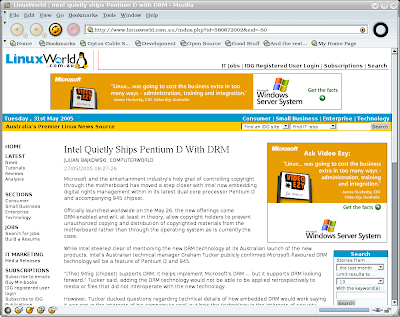
Initially I was a little stunned at what the Linux news website had allowed as advertising. I thought that this would send mixed messages to prospective Linux users. Think about a new user coming to the site for some information, only to find that they can "Get the facts" and stick with Microsoft. But then again, if you think about it, Microsoft in a way, is sponsoring the spread of Linux. They pay for the website to be up and running, and thus allow people to find out about Linux. I just wonder if Novell or Red Hat would adopt a similar marketing tactic and advertise on Windows web sites.

Initially I was a little stunned at what the Linux news website had allowed as advertising. I thought that this would send mixed messages to prospective Linux users. Think about a new user coming to the site for some information, only to find that they can "Get the facts" and stick with Microsoft. But then again, if you think about it, Microsoft in a way, is sponsoring the spread of Linux. They pay for the website to be up and running, and thus allow people to find out about Linux. I just wonder if Novell or Red Hat would adopt a similar marketing tactic and advertise on Windows web sites.
Monday, 24 January 2005
Some comments about last year...
Due to my attention being diverted by GNU/Linux on my Toshiba P20 last year, I didn't make many updates to the 2004 rants and rave page. I just wanted to make some comments on what I did last year.
Last year, I was lucky enough to be in a presentation given by two influential people in the Open Source / Free Software movement. The first one was Richard Stallman (you can scroll down the page of the link to find out what he looks like). Richard gave a very impressive speech on free software and how important it is to stop the mega-corporations just enforcing their rules on us - especially in Australia. It made much sense to hear him speak about how all software should be, and can be free (in the sense of freedom). People shouldn't be disheartened by the lack of quality free software, for if the software is truly free, it can continually be improved. And while there is some catching up to do in some areas of free software, eventually with enough effort and time, it will surpass proprietary (closed-source) software. I had never heard it termed like that before, and to me it made a lot of sense. After the presentation, I returned to my Linux machine and used in in a new type of passion (even though I have proprietary software on it in the form of Java and the nVidia drivers - but in the case of graphic cards, nVidia supports Linux with their proprietary drivers than ATI). At the end of the presentation, Richard offered some products to buy, and I purchased a GNU 20th anniversary pin. Hopefully that microscopic donation can power Richard to keep giving more of those speeches, and awakening people to the concept of free software around the world.
The other person I met that I consider a major influence in the Open Source community was Michael Tiemann. Michael talked on different topics to Richard. Where Richard spoke of the importance of keeping software free, Michael suggested many ways of how open source could make money (btw. Michael is more in-tuned with "Open Source", whereas Richard is more in-line with "Free Software" - there is a difference). I've always found it hard to come to terms with the concept of making money with something you can essentially sell once, but can be copied many times over. His idea (and that of Red Hat Linux) is not to make money from packaging up their property, as this means essentially once you ship a copy "out the door" your competitor can copy it and ship it too. The key is to make money by providing services, and selling value-added solutions to your customers. This allows for a very competitive market where innovating will mean that you're in the lead, and the customer wins as there is truly a free market. For example, if you're a customer of Red Hat, and they do something you don't like, you can change to SUSE Linux, due to the "exit costs" of going from Linux to Linux being very low. Michael also offered a better model of how to calculate Total Cost of Ownership (TCO). It should not just be calculated on purchasing or running costs, but it should also include exit costs too. Microsoft Windows appears to have a low TCO, but exit costs rarely enter into the equation. Sometimes upgrading between versions of Windows (eg. from Windows95 to WindowsNT4 to WindowsXP) and Microsoft products (like Office) are not as low as Microsoft would lead you to believe. The usual case is that things go wrong, and you'll end up uninstalling some other applications to make something work, and you'll find incompatibility between some versions. You've then got to factor in the cost of converting those products / documents into the new (Microsoft latest version friendly) format. A final point I took from Michael's presentation is that Open Source software gives people / companies the freedom to be different or be the same. If you like what other Open Source people / companies are developing, there is no harm in using that product as yours. If you don't, then there's no problems with writing your own. There are many more benefits that initially greet the eye. It also allows start-up companies basing their products on Open Source technologies to get a line-up of products in a relative short time.
Finally, one last point. Since I've started my "GNU/Linux on a Toshiba P20" page, I've met a few very interesting people. Some people have written to me about GNU/Linux (and how to install / use it). Some people have written to me about the Toshiba P20, but the majority that have written are about both. If you've got something you want to discuss with me, just feel free to write some e-mail to me. My address is rdefrance (at) gmail (dot) com. I look forward to corresponding with all.
Last year, I was lucky enough to be in a presentation given by two influential people in the Open Source / Free Software movement. The first one was Richard Stallman (you can scroll down the page of the link to find out what he looks like). Richard gave a very impressive speech on free software and how important it is to stop the mega-corporations just enforcing their rules on us - especially in Australia. It made much sense to hear him speak about how all software should be, and can be free (in the sense of freedom). People shouldn't be disheartened by the lack of quality free software, for if the software is truly free, it can continually be improved. And while there is some catching up to do in some areas of free software, eventually with enough effort and time, it will surpass proprietary (closed-source) software. I had never heard it termed like that before, and to me it made a lot of sense. After the presentation, I returned to my Linux machine and used in in a new type of passion (even though I have proprietary software on it in the form of Java and the nVidia drivers - but in the case of graphic cards, nVidia supports Linux with their proprietary drivers than ATI). At the end of the presentation, Richard offered some products to buy, and I purchased a GNU 20th anniversary pin. Hopefully that microscopic donation can power Richard to keep giving more of those speeches, and awakening people to the concept of free software around the world.
The other person I met that I consider a major influence in the Open Source community was Michael Tiemann. Michael talked on different topics to Richard. Where Richard spoke of the importance of keeping software free, Michael suggested many ways of how open source could make money (btw. Michael is more in-tuned with "Open Source", whereas Richard is more in-line with "Free Software" - there is a difference). I've always found it hard to come to terms with the concept of making money with something you can essentially sell once, but can be copied many times over. His idea (and that of Red Hat Linux) is not to make money from packaging up their property, as this means essentially once you ship a copy "out the door" your competitor can copy it and ship it too. The key is to make money by providing services, and selling value-added solutions to your customers. This allows for a very competitive market where innovating will mean that you're in the lead, and the customer wins as there is truly a free market. For example, if you're a customer of Red Hat, and they do something you don't like, you can change to SUSE Linux, due to the "exit costs" of going from Linux to Linux being very low. Michael also offered a better model of how to calculate Total Cost of Ownership (TCO). It should not just be calculated on purchasing or running costs, but it should also include exit costs too. Microsoft Windows appears to have a low TCO, but exit costs rarely enter into the equation. Sometimes upgrading between versions of Windows (eg. from Windows95 to WindowsNT4 to WindowsXP) and Microsoft products (like Office) are not as low as Microsoft would lead you to believe. The usual case is that things go wrong, and you'll end up uninstalling some other applications to make something work, and you'll find incompatibility between some versions. You've then got to factor in the cost of converting those products / documents into the new (Microsoft latest version friendly) format. A final point I took from Michael's presentation is that Open Source software gives people / companies the freedom to be different or be the same. If you like what other Open Source people / companies are developing, there is no harm in using that product as yours. If you don't, then there's no problems with writing your own. There are many more benefits that initially greet the eye. It also allows start-up companies basing their products on Open Source technologies to get a line-up of products in a relative short time.
Finally, one last point. Since I've started my "GNU/Linux on a Toshiba P20" page, I've met a few very interesting people. Some people have written to me about GNU/Linux (and how to install / use it). Some people have written to me about the Toshiba P20, but the majority that have written are about both. If you've got something you want to discuss with me, just feel free to write some e-mail to me. My address is rdefrance (at) gmail (dot) com. I look forward to corresponding with all.
Tuesday, 4 January 2005
Happy New Year to all...
Just want to start off the year wishing everyone a safe and prosperous 2005.
Thursday, 26 August 2004
Say no to "vendor lock-in"!
I know it's been a while since I've written anything, but as you know, I've been playing around with my PC and Linux. One thing I would like to point out with software is an awful scenario, where an entity becomes dependant on another entity for a piece of software. This is commonly known as "vendor lock-in". It's not a unique case. Many of you out there may already be "victims" of it without knowing.
Why is this bad you ask? What happens if the vendor you are relying on does something different in their product that you use, that all of a sudden stops working on your PC. What choices do you have left? Not much, I think.
One of the best features with Open Source software is the avoidance of "vendor lock-in". As the source is available, if one person doesn't offer the service you need, you could always fix it yourself, or employ someone to fix it for you.
Why have I brought this point up after many months of silence? Well I've just had some dealings with a large IT company which supports some Open Source Linux distributions. The only problem is they don't support Gentoo Linux (yes I know, more zealotry). Nothing would make me happier if this large IT company would release the application server and their source code management application so it was fully functioning with Gentoo, but alas, they only support Red Hat Enterprise Linux and SUSE Linux. Don't fall into the trap of believing their words, just say NO.
Why is this bad you ask? What happens if the vendor you are relying on does something different in their product that you use, that all of a sudden stops working on your PC. What choices do you have left? Not much, I think.
One of the best features with Open Source software is the avoidance of "vendor lock-in". As the source is available, if one person doesn't offer the service you need, you could always fix it yourself, or employ someone to fix it for you.
Why have I brought this point up after many months of silence? Well I've just had some dealings with a large IT company which supports some Open Source Linux distributions. The only problem is they don't support Gentoo Linux (yes I know, more zealotry). Nothing would make me happier if this large IT company would release the application server and their source code management application so it was fully functioning with Gentoo, but alas, they only support Red Hat Enterprise Linux and SUSE Linux. Don't fall into the trap of believing their words, just say NO.
Tuesday, 25 May 2004
So I'm quiet again...
I've been quiet on these pages as I've been working away on my machine at home, and playing around with the world of Open Source software. I can't believe how easy life can be with a well designed package management system. And yes, I am referring to Gentoo Linux. The more I use it, the more I appreciate it. I've also been chatting with work colleagues who were thinking of upgrading their operating systems. They were currently on some version of Red Hat Linux, and were asking me my opinion on what to go to next (this was around the time of the Red Hat - Fedora Project split). I mentioned to them about a system that never needs to be re-installed again. They were intrigued. They tried Gentoo. They have both said they will never look back! Effortless updates... you can't ask for more than that! Superb documentation. Great, friendly community. For zealotry like this, that money cannot afford, give it a go!
Tuesday, 27 April 2004
Installing software...
I've been busy, not on this "soap box page", but on getting Linux to run on my PC at home. For those of your that want to have a look as to what I'm up to, please visit my Linux on Toshiba page. That page has been quite active, as I have been updating it with what I've been doing with Gentoo Linux. I cannot sing the praises of that distribution enough. When I want to install some application, I find it's name in the application repository, and then type in one simple command to download it. It will then compile and install itself onto my hard-drive. "So what?" I hear you say... Well, it also looks at anything it depends on (libraries, environmental applications), and then downloads them as well. "So what? Microsoft Windows does it easier!" Well... yes and no! It does do it a little easier, as it does provide one standard set of widgets for all applications to use, but it still does not provide library protection. That basically means, sometimes if you install something, you may find some of your other applications just stop working, because they are depending on their old libraries being there... the old libraries you've just re-installed with the new version.
Gentoo eliminates all this by compiling everything from source and having an excellent dependency resolution system. So excellent, that most times I only have to type in the one command to bring down a complete open source system. Red Hat Linux (and other RPM based distributions) has their own system called RPM, but it does not do as good a job of getting software installed. There have been many articles about this on the web, commonly known as RPM Hell. Pick any of the articles to have a read. I have not yet seen one article praising RPM for going about installing software the right way. If there is one, please inform me and I'll update this page. I cannot really comment about Debian's way or Slackware's way of doing things, since I haven't used them properly before, but I will in the next few weeks / months.
Gentoo eliminates all this by compiling everything from source and having an excellent dependency resolution system. So excellent, that most times I only have to type in the one command to bring down a complete open source system. Red Hat Linux (and other RPM based distributions) has their own system called RPM, but it does not do as good a job of getting software installed. There have been many articles about this on the web, commonly known as RPM Hell. Pick any of the articles to have a read. I have not yet seen one article praising RPM for going about installing software the right way. If there is one, please inform me and I'll update this page. I cannot really comment about Debian's way or Slackware's way of doing things, since I haven't used them properly before, but I will in the next few weeks / months.
Wednesday, 14 January 2004
How much is that puppy...?
The wife and I recently picked up a Hungarian Vizsla puppy from a local Melbourne breeder. This dog is what I would consider one of the best dogs I have ever had. She's only a few weeks old, and is already familiar with her name, has almost mastered not going to the toilet in the house, and has picked up on a basic game of fetch. If you're considering getting a dog (and I was a pro-Welsh Corgi person for a long time), consider this breed too. If you're after details, please feel free to e-mail me, and I'll pass the details of the breeder to you.
Images of Vizslas can be found here (via the Google.com images search engine).
Images of Vizslas can be found here (via the Google.com images search engine).
Monday, 5 January 2004
Happy 2K4!
I hope you all had a safe festive period over the 2003 - 2004 period, regardless of your personal religious beliefs. I hope your 2004 is safe and prosperous in all aspects.
Monday, 29 December 2003
All the best to everyone!
I know it's a little late, but all the best to everyone over the festive season, regardless of belief. And may your 2004 be safe and prosperous.
Wednesday, 26 November 2003
The Toshiba P20 and Linux...
Ok... As mentioned in the last entry I've purchased the PC and I've attempting working with it. For my experiences, please have a look at this page.
Friday, 24 October 2003
Some ideas for content for this site...
I've been thinking for a while about something to write upon that would be of use to me an to many other people as well... I'm thinking something along the lines of a FAQ, but a topic-less FAQ... just questions I have asked myself many a time and searched the Internet for and not been able to find an immediate answer for. I'll take on board any suggestions any has, and even some question you may want to post. Just send them to the usual e-mail address.
On another topic of interest, I'm thinking of obtaining a notebook shortly. The one I currently have is a Toshiba Tecra 500CDT. It's about 7 years old, and is running a Intel Pentium I 120Mhz Chip, a broken (dry joint) CD ROM, 1.2 GB Hard Drive, and with Windows95 installed. I once tried loading Red Hat Linux 7.0 onto it, but due to my limited hard-drive, low memory (32MB), and then lack of knowledge, I got it up and running, but was frustrated at how slow everything ran in GNOME. This lead me to re-install Windows95. I know now I could have optimized it by switching off some services, and also choosing a lighter desktop. The laptop was good in it's day, but I think 7 years in IT changes many things. Saying that I'm thinking of upgrading to a Toshiba P20 (Clicking on this text will either trigger a download, or load a PDF into your browser. The PDF is originally from Toshiba Australia's Website. It comes with a Intel Pentium 4 2.8GHz Chip with HT, 80GB Hard Drive, DVD-RW/CD-RW, 17" wide screen, and many more features (but they're the main ones I'm interested in). What has all this got to do with content? Well I plan on documenting my installation of Linux on it. My strategy will consist of first restricting the WindowsXP partition of the hard drive to about 15GB, and dedicating the rest of it to Linux. I'll be attempting the following distributions in the following order: Knoppix (to get a feel of what's going on), followed by Red Hat / Fedora or Mandrake, then finally Gentoo. Wish me luck. I should be able to document my steps in a clear, understandable manner allowing those after me wanting to install Linux to find my information useful.
On another topic of interest, I'm thinking of obtaining a notebook shortly. The one I currently have is a Toshiba Tecra 500CDT. It's about 7 years old, and is running a Intel Pentium I 120Mhz Chip, a broken (dry joint) CD ROM, 1.2 GB Hard Drive, and with Windows95 installed. I once tried loading Red Hat Linux 7.0 onto it, but due to my limited hard-drive, low memory (32MB), and then lack of knowledge, I got it up and running, but was frustrated at how slow everything ran in GNOME. This lead me to re-install Windows95. I know now I could have optimized it by switching off some services, and also choosing a lighter desktop. The laptop was good in it's day, but I think 7 years in IT changes many things. Saying that I'm thinking of upgrading to a Toshiba P20 (Clicking on this text will either trigger a download, or load a PDF into your browser. The PDF is originally from Toshiba Australia's Website. It comes with a Intel Pentium 4 2.8GHz Chip with HT, 80GB Hard Drive, DVD-RW/CD-RW, 17" wide screen, and many more features (but they're the main ones I'm interested in). What has all this got to do with content? Well I plan on documenting my installation of Linux on it. My strategy will consist of first restricting the WindowsXP partition of the hard drive to about 15GB, and dedicating the rest of it to Linux. I'll be attempting the following distributions in the following order: Knoppix (to get a feel of what's going on), followed by Red Hat / Fedora or Mandrake, then finally Gentoo. Wish me luck. I should be able to document my steps in a clear, understandable manner allowing those after me wanting to install Linux to find my information useful.
Thursday, 21 August 2003
Ok... so I'm a little slack with this page still...
I'll admit I'm a little slack when it comes to updating this page. It's not like there's nothing I have to talk about (or "whinge" about)... It's just been that I've been busy at work... and unfortunately I need to work to pay bills...
The main thing that's been happening is the continual discussion of SCO vs. IBM and the associated fall out from SCO also going after users of the supposedly infringed code. This case appears more and more to me like a matter of interpretation of US Laws, and I for one do not know how this will apply to Australian Laws. It also appears to be a test in the US courts of how strong is the GPL License.
On another front, there is an increase in studies based on desktop deployments of Linux. I do believe that Linux is technically up to the task, and just needs to be sold to people who have a closed mind to anything but Microsoft. It looks like a massive up-hill battle, and it may wage on for a few years yet.
The main thing that's been happening is the continual discussion of SCO vs. IBM and the associated fall out from SCO also going after users of the supposedly infringed code. This case appears more and more to me like a matter of interpretation of US Laws, and I for one do not know how this will apply to Australian Laws. It also appears to be a test in the US courts of how strong is the GPL License.
On another front, there is an increase in studies based on desktop deployments of Linux. I do believe that Linux is technically up to the task, and just needs to be sold to people who have a closed mind to anything but Microsoft. It looks like a massive up-hill battle, and it may wage on for a few years yet.
Tuesday, 24 June 2003
I'm no Microsoft hater...
Reading through some of my opinions here and there, some people have come to the opinion that I'm opposed against Microsoft. There are plenty of "hate Microsoft" sites out on the web already. THIS IS NOT ONE OF THEM!
My actually issues with Microsoft is that I don't think they're writing to their best potential. I want their products to get better, but they continually disappoint me. I do not give up hope though. I hope that one day they will write something that is useful, secure, easy to use, etc... I'm probably more pro-Microsoft than Bill.
I don't think their strategic development agrees with my opinions though.
My actually issues with Microsoft is that I don't think they're writing to their best potential. I want their products to get better, but they continually disappoint me. I do not give up hope though. I hope that one day they will write something that is useful, secure, easy to use, etc... I'm probably more pro-Microsoft than Bill.
I don't think their strategic development agrees with my opinions though.
Friday, 20 June 2003
The skill of fishing...
The old proverb of "Give a man a fish, and he'll eat for a day. Teach a man to fish, and he'll eat for a lifetime" certainly does hold ground in the IT industry. I think people these days are in the mode of getting fish handed to them too often. This is not always a bad thing, but it can cause people to become too reliant on certain things being certain ways to remain productive.
I have no issue informing anyone who wants to ask me for information on how to achieve a certain goal. I don't believe in bottling information, skills, or techniques. It's not a belief that would allow for open-source projects to flourish so well. People should share ideas. Test (or use) ideas. Refine ideas. This sounds very Utopian, I know... but if we do strive to help each other, then we'll all get to a better (and more productive) state of doing things.
Empower your colleague or boss... and get them to do it themselves!!
I have no issue informing anyone who wants to ask me for information on how to achieve a certain goal. I don't believe in bottling information, skills, or techniques. It's not a belief that would allow for open-source projects to flourish so well. People should share ideas. Test (or use) ideas. Refine ideas. This sounds very Utopian, I know... but if we do strive to help each other, then we'll all get to a better (and more productive) state of doing things.
Empower your colleague or boss... and get them to do it themselves!!
Thursday, 29 May 2003
Something other than IT...
Just got in touch with two persons I haven't heard from in a long time. It's good to hear from both of them, although I honestly did not want to start communications with one of them.
All in all, I'm glad I did. Both have taken different paths in life (from each other and myself) but each seems happy.
Which leads me to the reason behind this snippet of thought...
If you do get the opportunity to get in touch with someone that you really want to, do it... regardless of what you have to do and any obstacles in the way...
I look forward to getting to know them both better (if I ever get the time to write them)...
All in all, I'm glad I did. Both have taken different paths in life (from each other and myself) but each seems happy.
Which leads me to the reason behind this snippet of thought...
If you do get the opportunity to get in touch with someone that you really want to, do it... regardless of what you have to do and any obstacles in the way...
I look forward to getting to know them both better (if I ever get the time to write them)...
Friday, 23 May 2003
A little off topic...
It's in the news a lot recently (have a look at this link to Google's news pages), but I was hoping to make a small comment about it here. The topic is SCO vs IBM (with Linux and Microsoft on the side). I don't know all the issues, but it seems to be a slow week for many technology reporters. After reading a dozen articles on the allegations made, I've come up with my own theories...
If this goes to court, it may take a long time. Think of one of the most publicized antitrust cases you can think of length. If a decision is made in court, will it later be overturned in an appeals court, or will the penalty be negotiated so that all sides can leave with their heads held high.
And finally, I don't think that many people (with the exception of the companies directly involved) are really fussed with it. From my understanding SCO issued out a letter to 1500 companies that utilized Linux, stating that they may be doing some type of illegal activity by using Linux. Since no companies were publicly named, I have not heard of any companies all of a sudden looking for alternate operating systems / environments to run their applications on.
Everyone should just get on with life.
If this goes to court, it may take a long time. Think of one of the most publicized antitrust cases you can think of length. If a decision is made in court, will it later be overturned in an appeals court, or will the penalty be negotiated so that all sides can leave with their heads held high.
And finally, I don't think that many people (with the exception of the companies directly involved) are really fussed with it. From my understanding SCO issued out a letter to 1500 companies that utilized Linux, stating that they may be doing some type of illegal activity by using Linux. Since no companies were publicly named, I have not heard of any companies all of a sudden looking for alternate operating systems / environments to run their applications on.
Everyone should just get on with life.
Thursday, 1 May 2003
Motivation and deadlines...
There seems to me (working in the Information Technology industry) that business customers get promised by management a delivery date, and then management want deadlines to be met. And if deadlines for delivery of code or functionality are not met, then accountability falls upon the developer / worker. But at the other end of the scale, authority and major decision making are still the domain of the management.
How is the IT worker supposed to remain motivated in the current climate of layoffs and pay cuts to meet deadlines?
My solution is simple (well it is to me I guess)...
How is the IT worker supposed to remain motivated in the current climate of layoffs and pay cuts to meet deadlines?
My solution is simple (well it is to me I guess)...
- Reverse the chain of command and decision making. The developer / worker makes the decisions, and management supports those decisions and MAKES THEM HAPPEN. Therefore management is the one accountable of what they promise to the business customer, and since the developer is working with the technology, they make the crucial decisions.
- Give people work that they want to do. Most people are happy putting many hours into something they are interested in. This will lead to more motivation, and more effort placed into the product simply because that person is interested in its development.
- Remove deadlines. Or don't over emphasis them. Some people do perform better under pressure, but most people will come up with better solutions in their own time.
- Pay more money. If you can't delivery on point #1, #2, or #3 then pay WELL. This is most likely the motivational factor for many people in the IT industry today.
Wednesday, 23 April 2003
You just can't help people who don't want to be helped...
I just don't get it sometimes. Even though there are better solutions out there, some people are real creatures of habit. They will insist on doing it their way and that their way is the ONLY way to do things correctly.
I guess that's why the majority of people are happy staying with what they know, instead of looking at something else that may better serve them. I have never found the transition to alternate operating systems an easy one (well, not until recently). Manually configuring the options of an operating system, especially from a text based install, has always given me anxiety, but the old saying does hold true - "If you never give it a go, then you'll never find out".
Saying all that, I don't think that alternate operating systems are for everyone. Some don't meet all my needs, but I like to keep an open mind.
I guess that's why the majority of people are happy staying with what they know, instead of looking at something else that may better serve them. I have never found the transition to alternate operating systems an easy one (well, not until recently). Manually configuring the options of an operating system, especially from a text based install, has always given me anxiety, but the old saying does hold true - "If you never give it a go, then you'll never find out".
Saying all that, I don't think that alternate operating systems are for everyone. Some don't meet all my needs, but I like to keep an open mind.
Subscribe to:
Posts (Atom)